Unpacking the Travel eSIM Business: Three Things Your Provider Isn't Telling You
Two eSIMs for the same country can run on different networks, throttle to different speeds and carry very different ad costs. How to tell them apart, and what Nimvoy does differently.
Every travel eSIM makes the same promise: land, switch on, you’re online. Here’s what separates a good one from an expensive one — and how we built Nimvoy around it.
Search “eSIM USA” or “eSIM China” and you’ll get a wall of brands that look identical: the same 200-country map, the same “unlimited data” badge, the same 60-second install claim. Underneath, they are not identical at all. Two eSIMs for the same country can run on different networks, slow you to very different speeds after your daily quota, and carry very different amounts of advertising cost in their price.
We started Nimvoy because we thought a travel eSIM should be judged on three things: the quality of the network behind it, an honest price, and attention to the details of each destination. This is how each of those actually works inside the eSIM business.
1. The eSIM is only as good as the carrier behind it
An eSIM isn’t a network. It’s a key. When you buy from a travel eSIM brand, you’re buying access to whichever local carrier that brand has a wholesale agreement with — and the cheapest wholesale agreement is rarely the best network. Most brands don’t lead with the carrier’s name for exactly that reason.
We pick the carrier first and set the price second. Two examples:
United States: Verizon + T-Mobile, not a single network. A Nimvoy US eSIM connects to both Verizon and T-Mobile, and your phone attaches to whichever signal is stronger where you’re standing. Many travel eSIMs sold for the US run on one network — frequently AT&T only. One network is one point of failure. That’s fine in Manhattan; it’s less fine halfway across a national park.
China: China Mobile, not the discount option. China Mobile is the country’s largest carrier with the widest coverage, particularly once you leave the first-tier cities. Most international eSIM brands — including the biggest marketplaces — put their China plans on China Unicom because it costs them less. Nimvoy’s China plans run on China Mobile. If your trip goes anywhere beyond Beijing and Shanghai, that choice is the difference between full bars and “searching.”
“Unlimited”: read the throttle speed, not the headline. Nearly every unlimited travel eSIM works the same way: a daily high-speed allowance (usually 3–5 GB), then a reduced speed until the next reset. The number that matters is the reduced speed. Across the major brands it’s typically around 1 Mbps, and some drop to 512 kbps — enough for texting, but slow or simply not working for most of what else you do on a phone.
Nimvoy’s unlimited plans reduce to 10 Mbps after the daily allowance, roughly ten times the industry norm. At 10 Mbps you can still stream in HD, sit through a Zoom call, and upload the day’s photos. Unlimited should mean you can keep using your phone, not just your messaging apps.
Sixty seconds to install. Quality also means not spending your first hour abroad in the settings menu. Buy before you fly, install in about a minute, and switch the line on when you land.
2. You’re paying for their ads
Here’s the uncomfortable math of this industry. Google’s own Keyword Planner shows what advertisers pay for the top of the page when someone in the United States searches “china esim”: between $2.04 and $6.83 per click, with competition rated High. Japan, France, Greece, Turkey — same story, $2.33 to $7.97 a click.
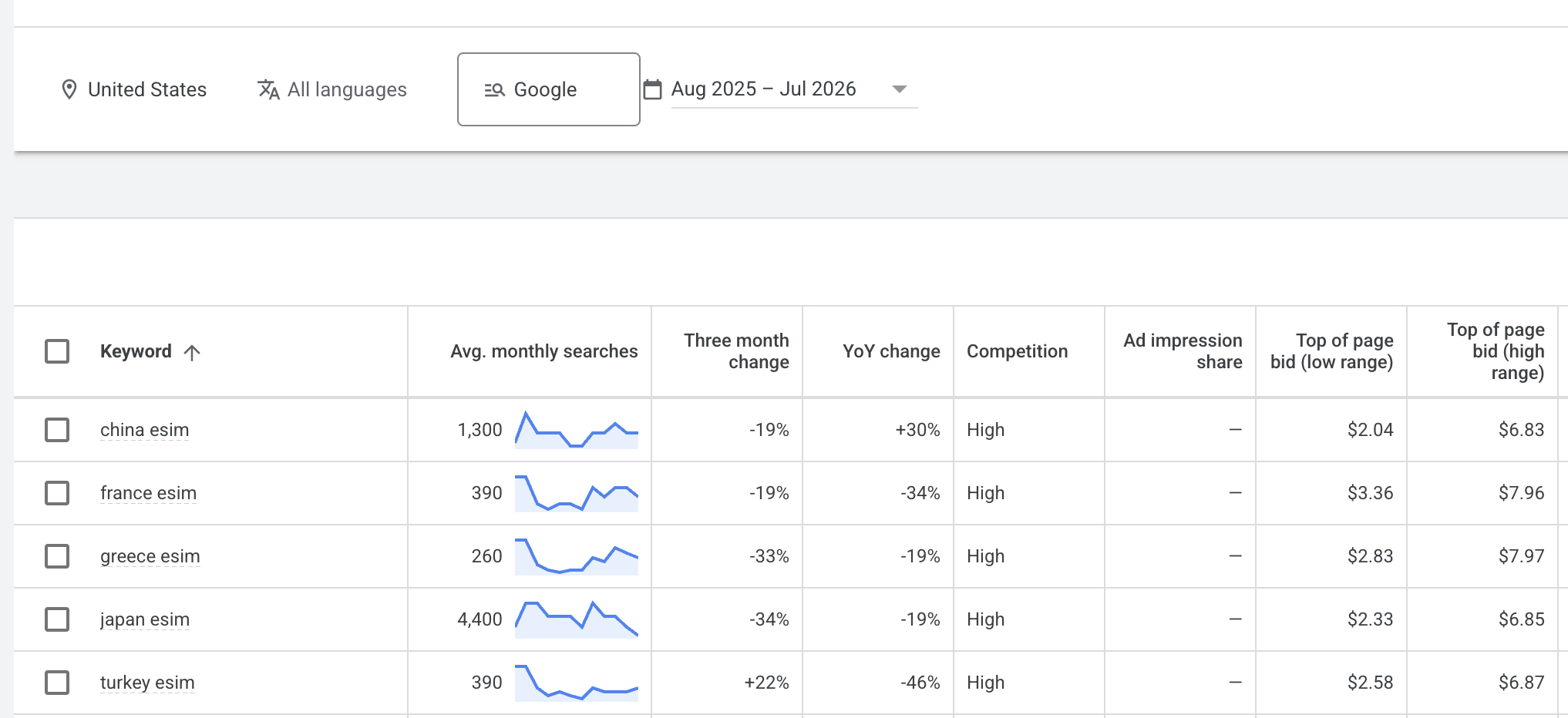
Google Keyword Planner, United States, Aug 2025 – Jul 2026. Top-of-page bid ranges for destination eSIM searches.
Only a small share of those clicks turns into a purchase. Even if one click in twenty becomes a sale — a generous rate — that’s $41 to $137 spent to win a single customer, more than most eSIM plans sell for.
That money doesn’t come from the ad platform. It comes from your plan price.
Nimvoy’s rule is simple: every dollar we don’t spend on advertising goes back into the price. We grow mostly through travel partners, word of mouth, and articles like this one, and our prices show it. Here is what a week in China costs, same country, same week:
| 7 days in China | Airalo (China Unicom) | Holafly (China Mobile) | Nimvoy (China Mobile) |
|---|---|---|---|
| 10 GB | $24.50 | Not offered (unlimited only) | $8.50 |
| Unlimited | $27.00 | $27.50 | $19.90 |
Ten gigabytes for a week is $24.50 at Airalo and $8.50 at Nimvoy: 65% less, on the network with better coverage. The gap holds across our fixed-data plans — 10 GB for 30 days is $10.90 with us and $26.50 there.
Competitor figures are from their published plan pages and fair-use policies as of September 2026. Prices change; check before you buy.
We’re not cheaper because we cut a corner on the network. We’re cheaper because our price isn’t carrying someone else’s ad bill.
3. One size fits nobody
Most eSIM brands sell 200 countries from a single catalog, and it shows: the same plan template, the same wholesale partner, the same fine print everywhere. We would rather get each plan right for the place it’s used.
China is the clearest case, because it’s the destination where the details bite hardest:
- The apps you actually use work. Nimvoy’s China plans route traffic through Hong Kong on China Mobile’s infrastructure, so Google, Gmail, Google Maps, WhatsApp, Instagram, YouTube and the popular AI apps — ChatGPT, Gemini, Claude — all work as normal. No VPN, no configuration, nothing to remember at 2 a.m. in Pudong.
- Best-coverage network, not lowest-cost network. China Mobile, as above. It matters most on high-speed rail, in the mountains, and in second- and third-tier cities.
- Install before you fly. Once you’re inside mainland China, foreign app stores and eSIM provider websites can be slow or unreachable. Install at home; switch on at the gate.
We apply the same thinking everywhere: dual networks where one carrier has gaps, higher post-quota speeds where “unlimited” is usually a fiction, and plan sizes that match how people actually travel.
The 60-second eSIM checklist
Before you buy any travel eSIM — ours included — ask five questions. A provider that won’t answer them is answering them.
- Which local carrier will I be on?
- One network, or more than one?
- On unlimited plans, how much high-speed data per day, and what speed after that?
- Will my apps work — especially in China?
- Can I install it before I leave, and how long does it take?
Nimvoy’s answers: named carriers on every plan; Verizon + T-Mobile in the US; 10 Mbps after your daily allowance; full app access in China without a VPN; a one-minute install before you fly.
The short version
An eSIM is three things: the network it puts you on, the price you pay, and whether it was built for the place you’re going. Most brands are vague on the first, expensive on the second, and identical on the third.
Nimvoy is specific on all three. Verizon and T-Mobile in the United States, so one weak signal never strands you. China Mobile in China, with Google, WhatsApp, Instagram and the popular AI apps working the moment you land, no VPN required. Unlimited plans that slow to 10 Mbps instead of a crawl, so “unlimited” still means something at the end of the day. And a price set by what the network costs, not by what it costs to be found: a 10 GB week in China is $8.50 with us and $24.50 with the biggest name in the business.
Better network, lower price, built for the destination. That is the whole pitch.
Nimvoy: local-SIM quality without the roaming bill. Plans for 200+ destinations at nimvoy.com.